Streamhouse and Lakestream
Streamhouse is an open, table-centric architecture that brings streaming, operational serving, and analytics onto a shared, lakehouse-native data foundation. It organizes workloads around reusable logical tables spanning fresh and historical data, so compatible consumers can share maintained data without each reconstructing an equivalent copy.
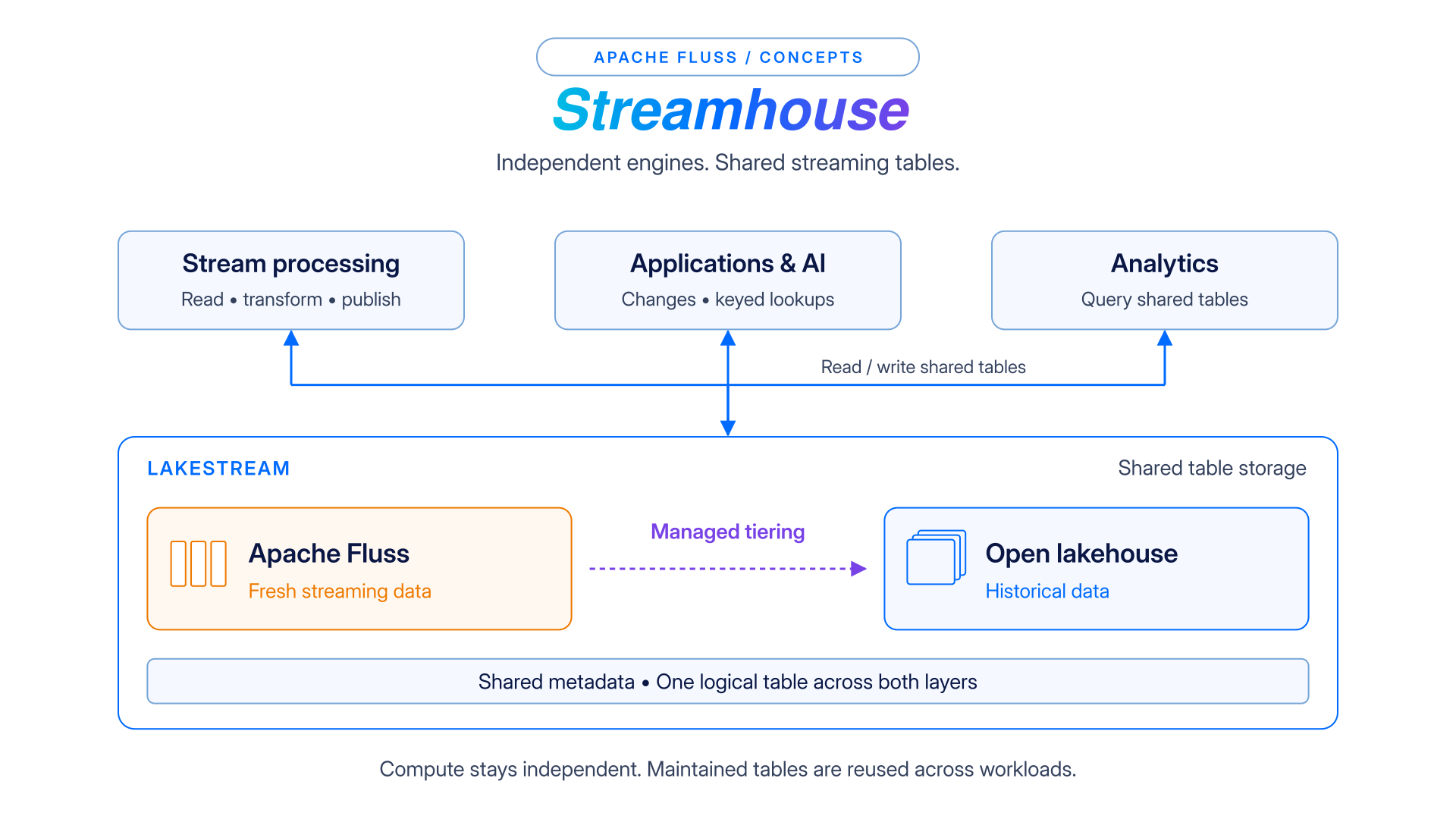
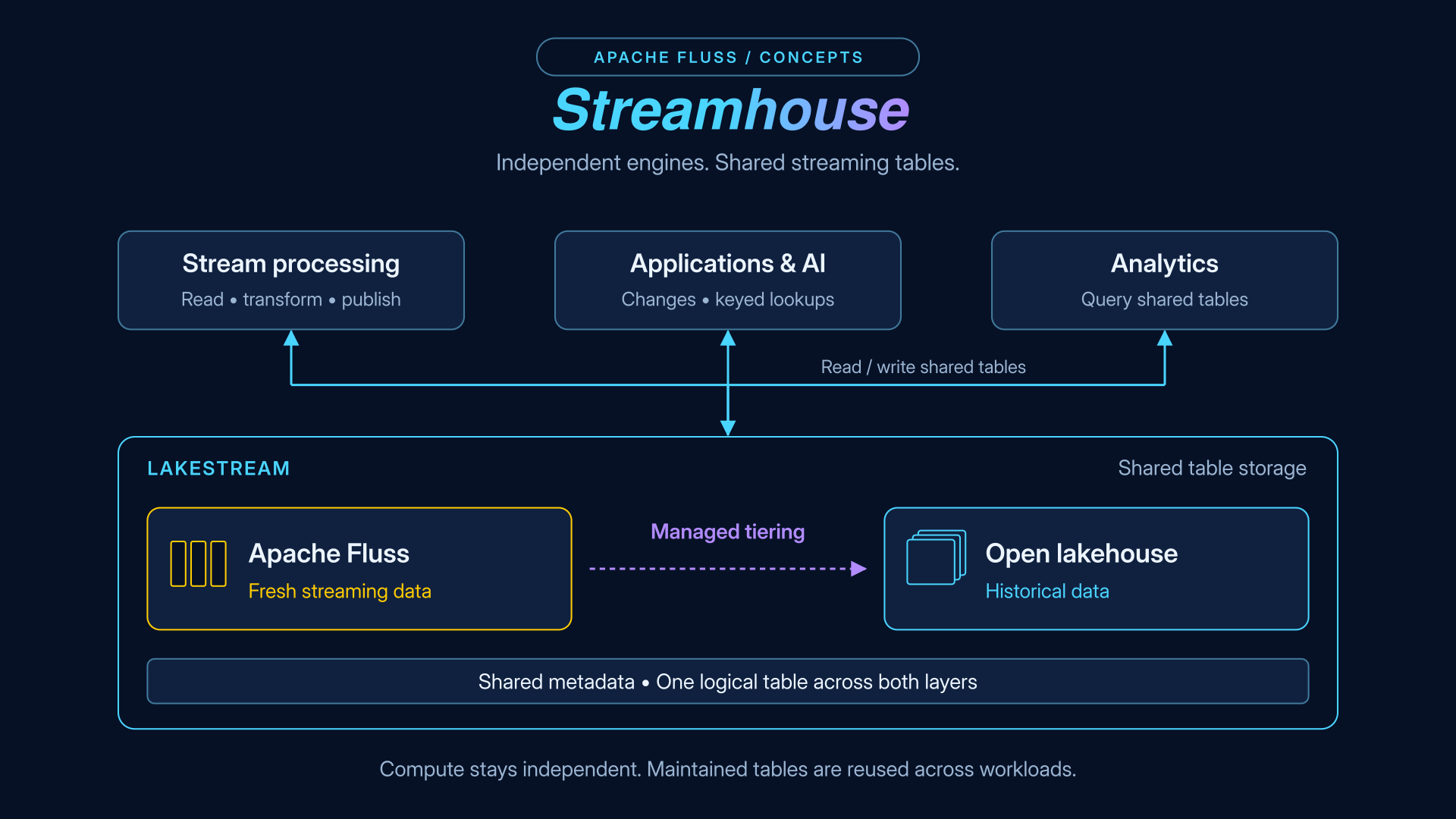
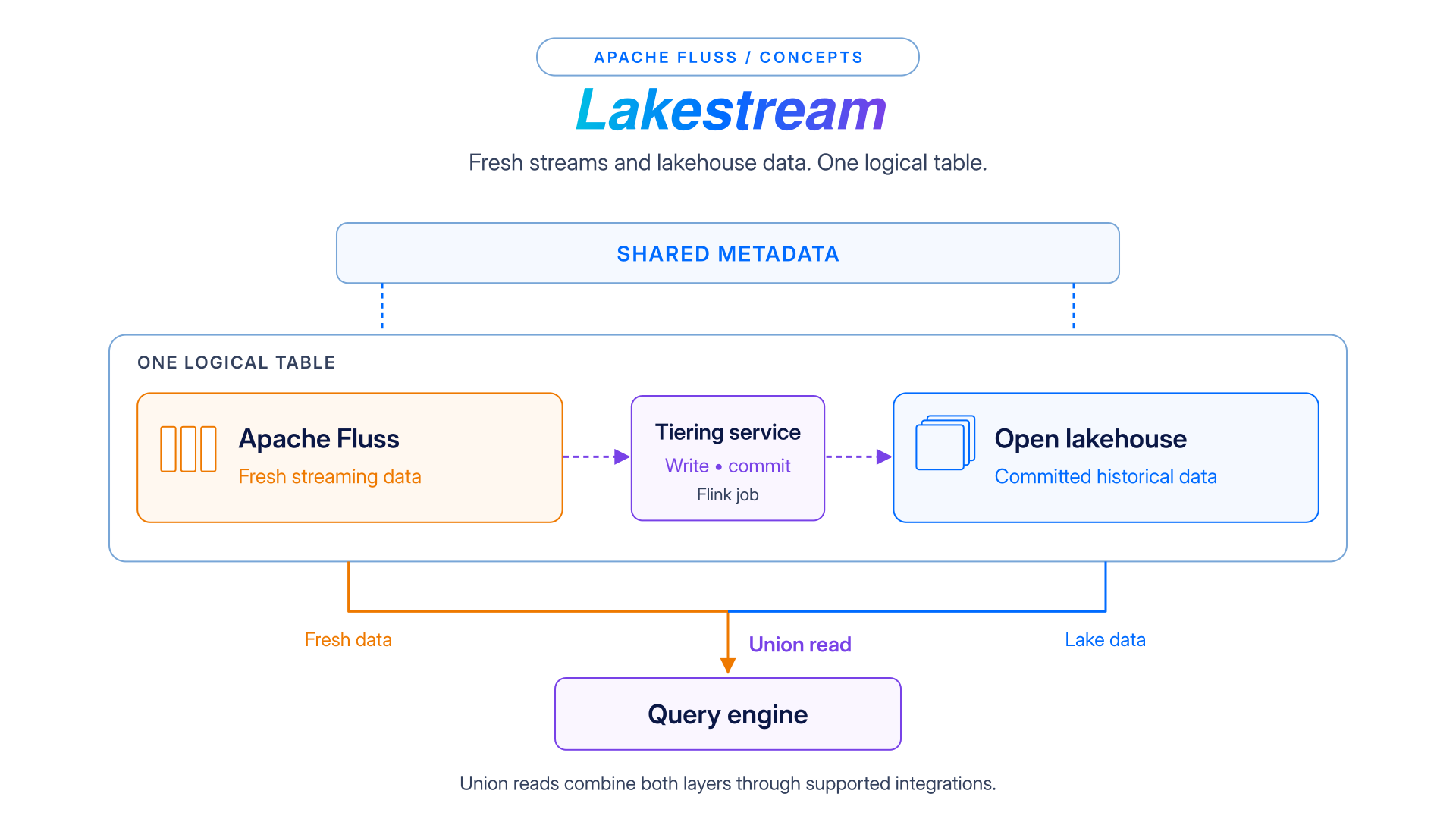
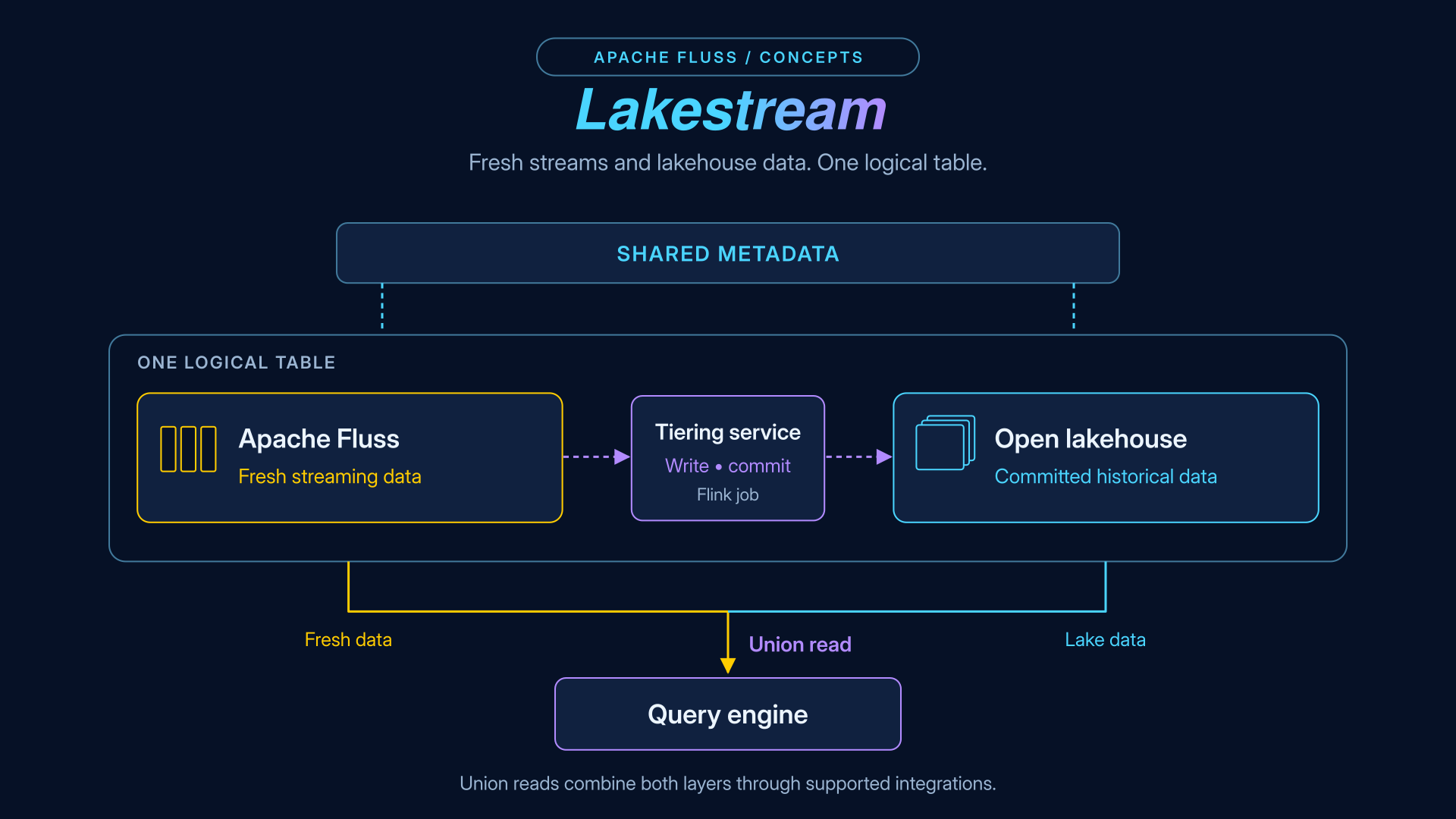
Lakestream is Streamhouse's open table storage foundation, unifying fresh data in streams and historical data in open lakehouse tables as different freshness layers of one logical table. Shared metadata, managed tiering, and supported access across the layers maintain that relationship.
| Concept | Responsibility |
|---|---|
| Streamhouse | The wider architecture: storage, independent compute engines, transformations, query and serving services, catalogs, governance, and applications. |
| Lakestream | The coordinated stream–lake storage foundation on which those workloads operate. |
| Apache Fluss | The streaming table layer and lakehouse integration that enable a concrete implementation of this foundation. |
From Event Delivery to Reusable Tables
A topic organizes publishing, retention, consumption, and replay of records. A table makes a dataset directly usable through shared columns, types, and supported operations. Where primary keys are supported, they identify rows and define update and delete semantics. Append-only tables also benefit from a defined schema and direct table access.
In a Streamhouse, an engine reads shared tables, performs a transformation, and writes its reusable result back as another table. Other workloads can access that maintained result through compatible interfaces. Engines still own their computations, including private execution state such as windows and timers. Catalogs make tables discoverable; governance defines ownership and access.
One Logical Table Across Streams and Lakes
Lakestream coordinates the identity, schema, and interpretation of a table across its streaming and lakehouse representations. Streaming storage supports continuous changes and fresh access; lakehouse storage supports efficient scans and longer retention.
Freshness describes how far each representation has progressed through incoming changes. A new update may change a key that has existed for years, and the physical representations may overlap. One logical table can therefore span multiple storage engines, layouts, and physical copies.
Independent Engines and Open Access
Compute engines run transformations and queries, and publish reusable results as shared tables. Applications choose how to retrieve and use those results. Replicas, caches, and specialized indexes may still serve a distinct purpose.
An engine may consume table changes, read committed lake data, or combine streaming and lake data through a supported union-read integration. A lake-compatible engine alone does not automatically provide union reads. Query response time and data freshness are separate concerns, and sharing tables does not imply a simultaneous snapshot across all tables and engines.
Explore Further
- Fluss Architecture: Understand the coordinator, tablet servers, and storage components.
- Lakestream Overview: Learn how Fluss coordinates metadata, tiering, and reads.
- Table Design: Choose table types, partitions, and buckets.
- Lakestream Quickstart: Try managed tiering and Union Read with Docker.